Last Updated: August 2026
The coach who brought Toronto its only NBA championship says the province owes him nearly $700,000. Ontario says he does not qualify, because by the time he applied for his refund, he had already sold the house.
That is the whole fight. Not fraud, not speculation, not a technicality about who he is. A question of when he filed.
And it is a question that could apply to a lot of people who are not NBA coaches.
What Actually Happened
In the fall of 2021, Nick Nurse and his wife Roberta bought a home just north of Port Credit in Mississauga for $4.65 million.
Nurse was an Iowa native coaching the Raptors, employed by Maple Leaf Sports & Entertainment. Legally, he was a foreign national. That meant Ontario's Non-Resident Speculation Tax applied to the purchase.
The bill was $697,500.
Here is the part people miss: the tax was never meant to be permanent for someone in his position. Ontario built rebates into the system precisely so that foreign nationals who came here, worked here, and lived here could get the money back once they proved they were not speculators.
Nurse qualified for one of those rebates. According to the notice of appeal, he became eligible on October 15, 2022, after completing a continuous year of full-time employment in Ontario under a valid work permit.
Then things got complicated.
The Timeline
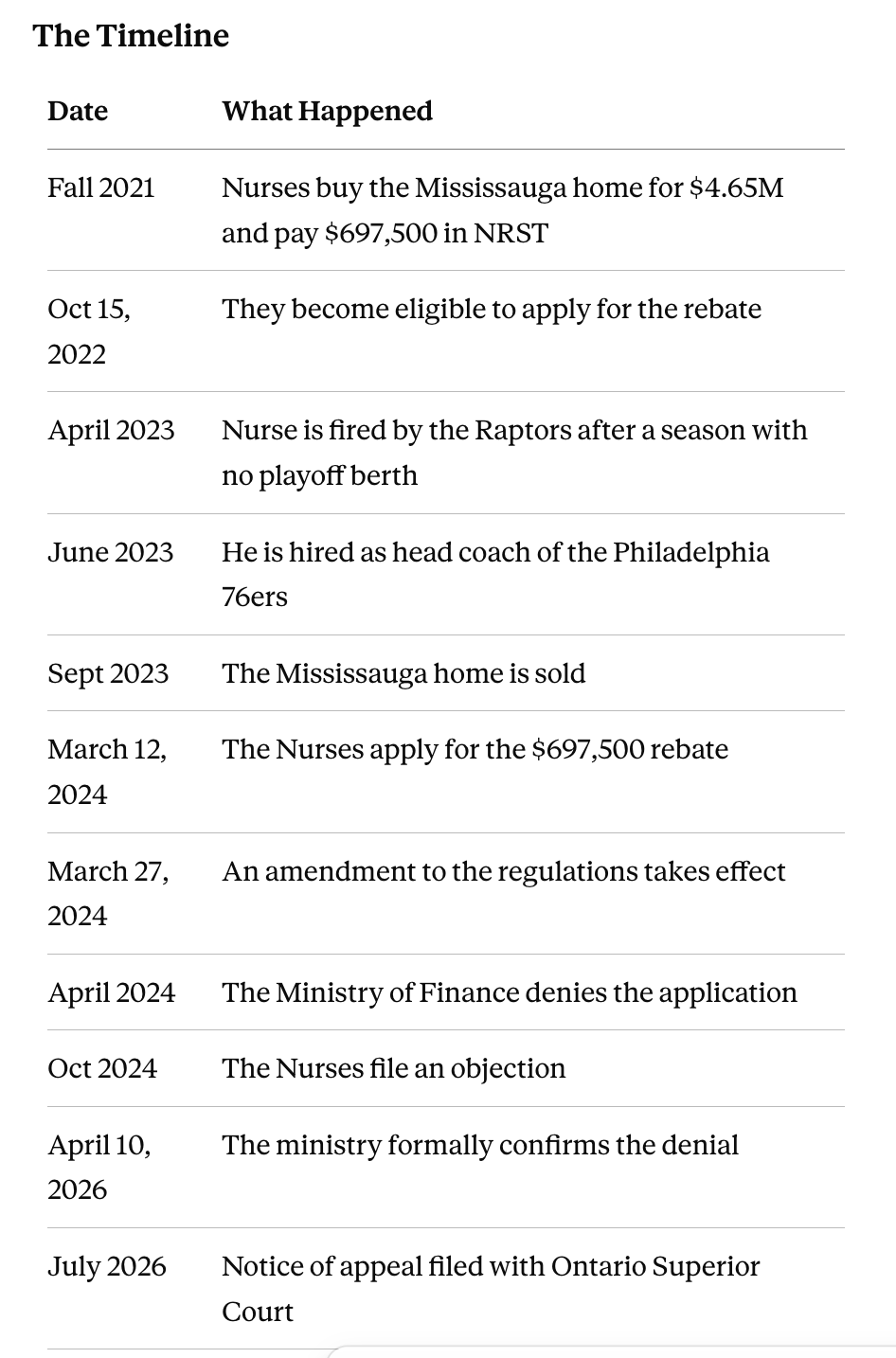
Look at the gap between October 2022 and March 2024. Seventeen months of eligibility, unused.
In that window, he got fired, took a job in another country, and sold the house.
Why the Ministry Said No
The Ministry of Finance denied the application because, according to the court filing, the couple had not occupied the property up to the date they made their application.
By March 2024, the house belonged to someone else.
The Nurses' position, per their notice of appeal, is that this was not one of the residency requirements at the time they submitted the request. Their lawyer, Mike Collinge, told the Toronto Star the couple "are simply following the appeal process set out in the Land Transfer Tax Act to challenge a statement of disallowance that, in our view, is incorrect."
The appeal also argues something more human: that Nurse "brought significant economic and social value to the province," and that he and his wife "were not the type of real estate speculators the legislature aimed to address."
That second point is hard to argue with on the merits. A head coach who moved his family to Mississauga, lived in the house for two years, and won a title for the city is not exactly a shell company parking capital in a condo.
But tax statutes generally do not care about vibes. They care about conditions being met, in order, on time.
A Quick Primer on the Non-Resident Speculation Tax
If you have never encountered the NRST, here is the short version.
Ontario introduced it in 2017 at 15 per cent, applying only to the Greater Golden Horseshoe. In March 2022 it went to 20 per cent and expanded province-wide. In October 2022 it was raised again to 25 per cent, where it sits today.
It applies when a foreign national, foreign corporation, or taxable trustee acquires residential property in Ontario containing one to six single-family residences.
One detail that surprises people: if any one of the buyers on title is a foreign entity, the tax generally applies to the entire purchase price. It is not prorated by ownership share. A Canadian citizen buying a $1 million home with a foreign national spouse can be looking at a $250,000 tax bill on a property they half own.
The Rebate Landscape Has Changed
The rebate Nurse applied for, the one tied to holding a valid work permit and working full-time in Ontario for a year, no longer exists for new purchases. Ontario eliminated the work permit and international student rebates in 2022.
What remains today is narrower:
- Permanent resident rebate. Generally available if the buyer becomes a permanent resident of Canada within four years of the registration date, subject to occupancy and filing conditions.
- Industrial use rebate. A newer category for residential property converted to industrial use, for conveyances on or after November 6, 2025.
So the door Nurse is fighting his way back through is a door that has since been bricked over. If you are a foreign national buying in Ontario in 2026, permanent residency is essentially the path.
The Real Lesson Here, and It Is Not About Basketball
Strip away the celebrity and this is a sequencing problem.
The Nurses appear to have met the substantive test. They lived in the home. He worked here full-time. He held a valid permit. The money was refundable in principle.
What may have gone wrong is that they became eligible, then waited, and by the time they filed, the facts on the ground had changed. You cannot occupy a home you no longer own.
This is the pattern behind an enormous number of expensive real estate mistakes, and almost none of them involve $697,500:
- The HST new housing rebate that requires you to move in, not rent out
- The first-time buyer land transfer tax refund with its own application window
- The principal residence designation that hinges on how a property was actually used
- The NRST rebate that generally expects you to still be there when you ask
Every one of these is a deadline wearing the costume of a benefit.
And here is the uncomfortable truth: nobody at your closing table is necessarily obligated to tap you on the shoulder eighteen months later and say "hey, you should file that now."
When a benefit has a clock attached, someone has to be watching the clock. Usually that someone is you.
What This Might Mean If You Are a Foreign Buyer
Nothing here is legal advice, and every file turns on its own facts. But a few habits tend to help:
- Get the rebate conditions in writing at closing. Not the summary. The actual conditions, with dates.
- Calendar your eligibility date and your filing date separately. Being eligible is not the same as having applied.
- File before you change anything material. Selling, moving out, refinancing, or changing immigration status may affect a claim that would otherwise have been fine.
- Assume the rules can shift under you. The Nurses filed fifteen days before an amendment to the regulations took effect. Rules around the NRST have moved repeatedly since 2017.
- Ask your lawyer specifically about NRST before you sign, not after. The tax is generally payable on registration. Discovering it at the closing table is a bad afternoon.
Where a Real Estate Lawyer Fits In
Most buyers meet their real estate lawyer roughly ten days before closing, sign what is put in front of them, and never speak to that lawyer again.
That model works fine when the deal is simple. It works less well when the deal carries a six-figure conditional tax and a rebate with a clock on it.
At Deeded, NRST exposure is something we look at early, not at the signing appointment, because the useful conversation about a $250,000 line item happens while you still have options. Flat-rate pricing means asking a follow-up question in month fourteen does not come with a surprise invoice attached.
If you are a foreign national buying in Ontario, or a Canadian buying with a partner who is not yet a permanent resident, that conversation is worth having before the offer goes firm.
Buying, selling, or refinancing? Get a free quote from Deeded in under 60 seconds.
How This Might End
The Nurses are asking Ontario Superior Court for the $697,500, plus interest and costs. The Ministry of Finance did not respond to the Star's questions.
The legal question is reasonably narrow: did the occupancy-up-to-application-date condition actually exist in the regulations on March 12, 2024, or did the ministry apply a standard that had not yet been written?
If the court finds the requirement was not in force at the time, the Nurses may get their money. If it finds otherwise, a championship coach becomes an expensive footnote in Ontario tax law.
Either way, the takeaway for everyone else is the same. The tax was refundable. The clock was not.
Disclaimer: This article provides general information only and does not constitute legal or tax advice. Non-Resident Speculation Tax rules, rebate conditions, and filing deadlines change frequently and outcomes depend heavily on individual circumstances. Please consult a qualified lawyer or tax professional about your specific situation.
Unlock Your Seamless Closing Experience
Your Journey to a Worry-Free Closing Starts Here!