
A virtual real estate closing is the process of completing a real estate transaction — reviewing, signing, and notarizing all legal documents, entirely online, without visiting a lawyer's office in person.
Using secure video technology and legally recognized digital signatures, you work with a licensed real estate lawyer remotely to finalize your home purchase, sale, or mortgage from anywhere you have an internet connection.
Why Virtual Closings Matter for Homebuyers
Buying a home is one of the largest financial decisions you'll ever make and traditionally, it came with a mandatory trip to a lawyer's office in the final days before your closing date. You'd take time off work, find a way to get there, sit across a desk, and sign a stack of papers you may not have had much time to review.
For most Canadians, that's just "how it was done."
That's changed. Virtual real estate closings are now legally permitted and professionally supported across Ontario, Alberta, and other Canadian provinces, and they're quickly becoming the preferred option for a growing number of homebuyers and sellers.
The convenience factor is obvious, but virtual closings offer more than just flexibility. They give you time and space to actually understand what you're signing, with your lawyer available by video to walk you through every document. For first-time homebuyers especially, the virtual closing model can feel less rushed and more transparent than a traditional in-office signing.
When you're sitting in a waiting room and a paralegal slides 40 pages across the desk, it's easy to feel pressured to sign quickly. A virtual closing puts you in your own environment, on a secure platform, with the documents in front of you and a lawyer on screen to answer every question you have.
How a Virtual Real Estate Closing Works: Step by Step
The process follows the same legal structure as a traditional closing. The difference is that everything happens through a secure online platform instead of in a physical office.
Step 1: Engage Your Real Estate Lawyer
You'll retain a licensed real estate lawyer who supports virtual closings. Companies like Deeded offer secure virtual closing and can get your closing process started in minutes. They'll receive your Agreement of Purchase and Sale and begin the title search and legal review process. This is the same work they'd do for an in-person closing.
Step 2: Receive Your Documents Digitally
A few days before your closing date, your lawyer will upload your closing documents to a secure client portal. You can review them at your own pace before your signing appointment and have the opportunity to ask any questions you may have, ahead of the signing meeting. These documents typically include your mortgage instructions, transfer of title, and various statutory declarations.
Step 3: Attend Your Video Signing Appointment
At your scheduled time, you connect with your lawyer through an encrypted video call. Your lawyer will guide you through each document, explain what you're signing, witness your signatures in real time, and handle any last-minute questions. This video-witnessed signing is legally recognized under Ontario's *Electronic Commerce Act, 2000* and the *Commissioners for Taking Affidavits Act* (for virtual commissioner of oaths services).
Step 4: Digital Signatures and Notarization
You'll apply your digital signatures to the documents through the platform. Where a notarized or commissioned document is required, your lawyer acts as a commissioner of oaths via the video call — a process that has been formally recognized in Ontario since legislative updates enabled remote commissioning.
Step 5: Funds and Registration
Your lawyer coordinates the transfer of closing funds (typically received through a trust account wire or certified payment) and registers the title transfer with the Land Registry Office electronically which, notably, has been done electronically in Ontario since 1999 through the Teranet system. The title change has always been digital; now the signing process can be too.
Step 6: Keys and Confirmation
Once registration is confirmed, your lawyer notifies you and coordinates key handover with your real estate agent. You're a homeowner.-
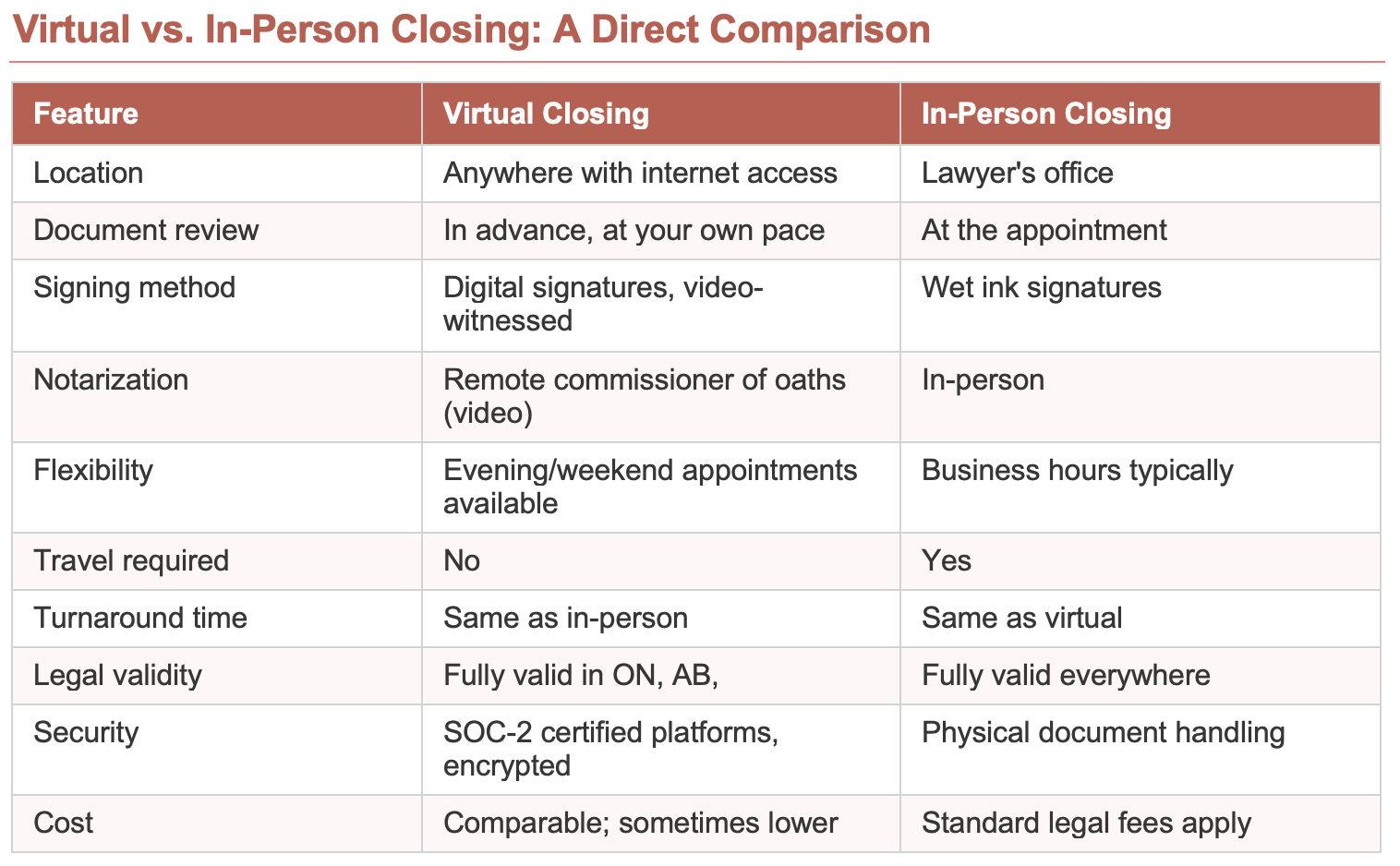
Are virtual closings legal in Ontario?
Yes — unequivocally. Virtual closings in Ontario are fully legal, professionally regulated, and in manycases more secure than traditional paper-based processes.
On the legal side, Ontario's Electronic Commerce Act, 2000 established the foundation for electronic document execution. Subsequent amendments and Law Society of Ontario guidance have clarified that lawyers can commission documents remotely via video, providedthey can verify the identity of the person signing. Deeded's platform supports identity verification that meets Law Society of Ontario standards, ensuringevery closing is conducted in full compliance with professional obligations.
On the security side, Deeded is SOC-2 certified — a third-party security audit framework that evaluates a platform's controls around security, availability, and confidentiality. This means an independent auditor has verified that the systems protecting yourpersonal and financial information meet enterprise-grade security standards.
What Technology Is Used in a Virtual Closing?
A virtual closing relies on a combination of established and purpose-built technologies, all working togetherwithin a compliant legal framework:
• Secure client portal: All documents are uploaded, reviewed, and stored in an encrypted portal. You access everything through a single authenticated login.
• Encrypted videoconferencing: Your signing appointment takes place over a secure, encrypted video connection structured to meet the witnessing requirements under Ontario law.
• Digital signatures: Legally recognized under the Electronic Commerce Act, 2000, digital signatures carrythe same weight as wet ink signatures. The platform creates an auditable signature trail — timestamp, IP address, and authentication.
• Identity verification: Before signing, you verify your identity through the platform using government-issued photo ID.
How Does Cost Compare to a Traditional Closing?
Legal fees for real estate closings in Ontario typically include a base professional fee, disbursements(title search, registration fees, title insurance, etc.), and applicable taxes. These costs apply regardless of whether your closing is virtual or in-person —your lawyer is doing the same legal work either way.
Virtual closings don't carry a premium. In some cases, they may be slightly more cost-effective because they reduce administrative overhead for the firm. What you're paying for is the legal expertise, not the cost of maintaining a physical office waiting room.
A Real-Life Example: Priya Buys Her First Condo in Toronto
Priya's Story
Priya is a first-time homebuyer purchasing a $620,000 condo in Toronto. She works full-time as a project manager and her closing date is on a Thursday. Taking a half-day off work to visit a lawyer's office in the middle of the city would cost her vacation time and parking — minor inconveniences, but real ones.
Instead, she books a virtual closing through Deeded. Three days before closing, she receives secure access to her portal and spends 45 minutes reviewing her documents at home.
On closing day, she connects via encrypted video with her Deeded lawyer at 10 a.m. By 10:45 a.m., all documents are signed. By 3:00 p.m., title is registered in her name. Her real estate agent drops off the keys that evening.
Priya didn't take time off work. She didn't drive downtown. And she felt genuinely informed about every document she signed.
How Deeded Facilitates Virtual Real Estate Closings
Deeded was purpose-built to make virtual real estate closings the standard, not the exception. The platform connects homebuyers, sellers, and mortgage professionals with our licensed real estate lawyers in Ontario and Alberta through a SOC-2 certified, end-to-end virtual closing process — from document upload to title registration.
If you're buying, selling, or refinancing and want a closing experience that's secure, transparent, anddoesn't require you to rearrange your day around an office visit, Deeded isbuilt specifically for that.
Frequently Asked Questions
Is a virtual real estate closing legally valid in Ontario?
Yes,virtual closings are fully legal in Ontario under the Electronic Commerce Act,2000 and Law Society of Ontario guidance for remote commissioning. Documents executed through a compliant virtual closing platform carry the same legal weight as those signed in person.
Do I still need a real lawyer for a virtual closing?
Yes— and you should want one. A licensed real estate lawyer reviews your title, manages the funds, handles registration, and advises you on the legal aspects of your transaction. The 'virtual' part refers to where the signing happens, not whether legal expertise is involved.
What if I'm not comfortable with technology?
Virtual closing platforms are designed to be straight forward, and your lawyer will guide you through the process in real time on your video call. Deeded's team is also available to walk you through the platform before your appointment.
Is my personal information safe on a virtual closing platform?
On Deeded's platform, yes. Deeded is SOC-2 certified, meaning an independent third-party auditor has verified the security controls protecting your data.
What documents will I sign at a virtual closing?
A typical purchase closing includes the transfer of title, mortgage instructions from your lender, a statement of adjustments, a direction regarding funds, and various statutory declarations. Your lawyer will explain each one during your signing appointment.
Can I do a virtual closing if I have a co-buyer or co-signor?
Yes.Both parties can join the same video call from the same or different locations, and both will sign through the platform. Your lawyer will verify each person's identity and witness both signatures.
How far in advance do I need to book a virtual closing?
It's best to engage your real estate lawyer as soon as your offer is accepted —ideally at least two to three weeks before your closing date.
Is a virtual closing available for refinances, not just purchases?
Yes.Virtual closings work for purchases, sales, and mortgage refinances. The process is the same: your lawyer reviews the documents, you sign via the secure platform on a video call, and the new mortgage is registered electronically.
Unlock Your Seamless Closing Experience
Your Journey to a Worry-Free Closing Starts Here!


