
By Deeded.ca | Last updated: March 18, 2026
TL;DR: Canada's First-Time Buyer GST Rebate, introduced through Bill C-4, eliminates the federal GST on newly built homes priced up to $1 million for eligible first-time buyers. The maximum savings are $50,000 per purchase, and up to $130,000 when combined with Ontario's proposed provincial rebate. The program applies to agreements signed between March 20, 2025 and December 31, 2030.
Canada's new First-Time Buyer GST Rebate is now law. On March 12, 2026, Bill C-4, the Making Life More Affordable for Canadians Act, received Royal Assent, officially eliminating the GST on newly built homes priced up to $1 million for eligible first-time buyers. According to the Department of Finance Canada, the savings can reach up to $50,000 per purchase.
Here's everything you need to know about who qualifies, how much you can save, and how to claim the First-Time Buyer GST Rebate.
What Is the First-Time Buyer GST Rebate?
The First-Time Buyer GST Rebate refers to a federal rebate introduced through Bill C-4 that eliminates or significantly reduces the Goods and Services Tax on newly constructed homes purchased by eligible first-time buyers in Canada. In short, it means that qualifying buyers of new homes no longer pay federal GST at the point of sale.
The rebate works on a tiered structure based on the home's purchase price:
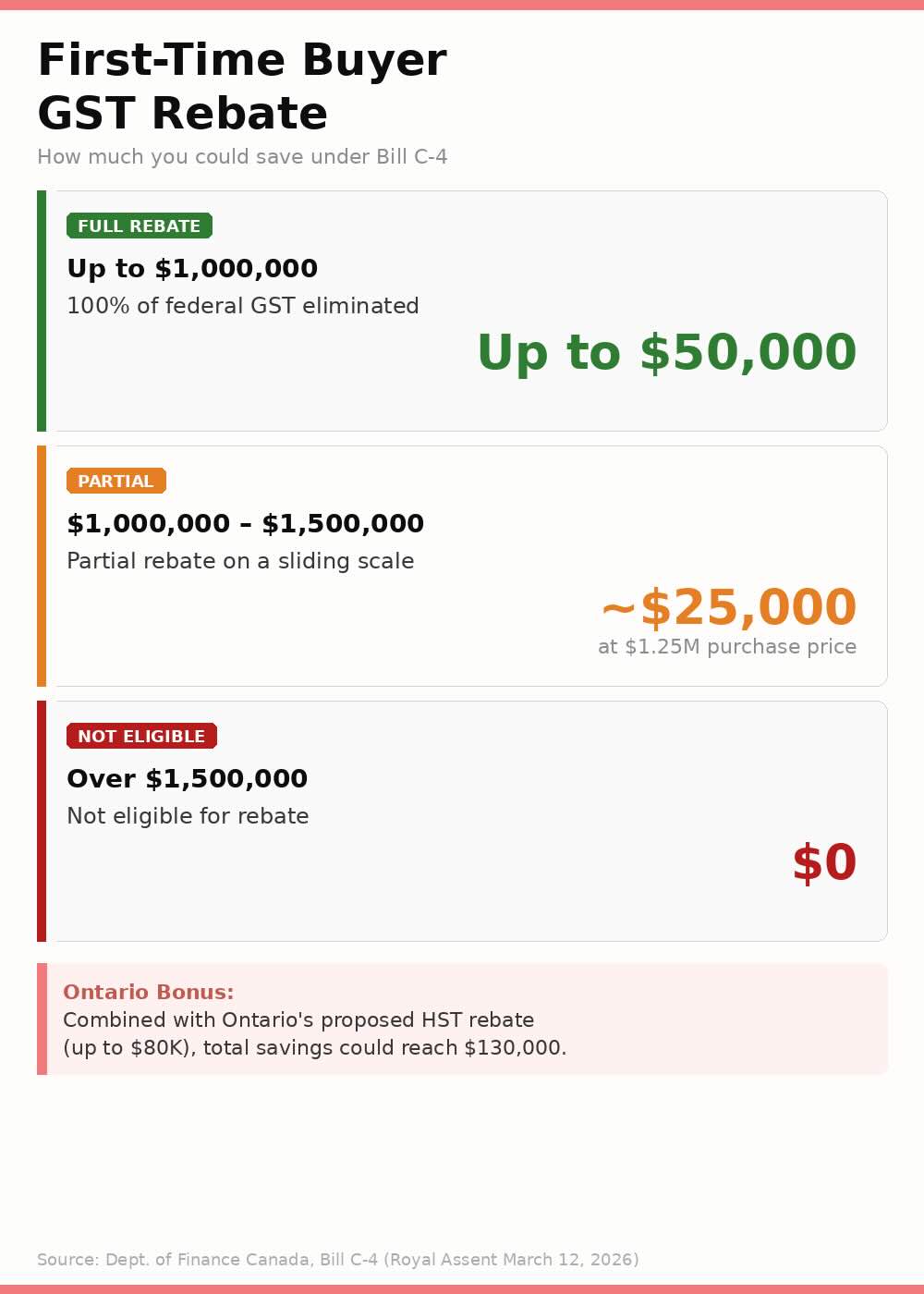
The First-Time Buyer GST Rebate applies to the federal GST or the federal portion of the HST in harmonized provinces. It covers newly built homes and substantially renovated properties only. Resale homes are not eligible.
How Much Can You Save with the First-Time Buyer GST Rebate?
A first-time buyer purchasing a newly built home at or below $1 million saves up to $50,000 in federal GST. For homes between $1 million and $1.5 million, the savings decrease proportionally. According to PwC Canada's analysis of Bill C-4, a home purchased at $1.25 million would qualify for approximately $25,000 in relief.
In Ontario, the savings could be even larger. The province has proposed a matching provincial HST rebate worth up to $80,000 on the provincial portion of the tax. If both the First-Time Buyer GST Rebate and Ontario's provincial rebate apply, the combined savings on a home under $1 million could reach $130,000. Ontario's proposal is not yet law at the time of writing, but it's worth tracking closely. Other provinces with harmonized sales taxes may follow with their own enhancements.
Who Qualifies for the First-Time Buyer GST Rebate?
To qualify for the First-Time Buyer GST Rebate, you must meet all of the following criteria, or use our wizard below.
- Age: You must be at least 18 years old at the time of purchase.
- Residency status: You must be a Canadian citizen or permanent resident.
- First-time buyer status: You must not have owned and occupied a home as your primary residence at any point during the current calendar year or the four preceding calendar years.
- Primary residence: The property you're purchasing must be intended as your primary place of residence.
- First occupant: You must be the first person to occupy the home after construction or substantial renovation is complete.
- Property type: The home must be a newly built or substantially renovated property. Resale homes do not qualify.
This definition is consistent with how "first-time buyer" is interpreted across other federal programs like the Home Buyers' Plan (HBP) and the First Home Savings Account (FHSA), so if you've qualified for those, you'll likely qualify here too.
When Does the First-Time Buyer GST Rebate Apply?
The First-Time Buyer GST Rebate has specific eligibility windows. Your agreement of purchase and sale must be entered into on or after March 20, 2025, and before January 1, 2031. Construction or substantial renovation must begin before 2031 and be substantially completed before 2036.
According to the Canada Revenue Agency, rebate claims have been processed since Royal Assent on March 12, 2026.
Can I Get the First-Time Buyer GST Rebate If I Already Closed?
Yes. If you signed your purchase agreement on or after March 20, 2025, and your closing took place before March 12, 2026 (when Bill C-4 became law), you are still eligible for the First-Time Buyer GST Rebate.
Because the legislation wasn't yet in force when you closed, your builder would not have been able to credit the rebate on your statement of adjustments. This means you'll need to apply directly to the CRA to claim your rebate retroactively. CRA forms for the enhanced rebate are expected to be available shortly.
How Do I Claim the First-Time Buyer GST Rebate?
For transactions closing after March 12, 2026, the First-Time Buyer GST Rebate is built into the closing process.
Builders can now credit the rebate directly on the statement of adjustments, effectively reducing the purchase price by the GST amount. The builder then claims the rebate from the CRA on your behalf.
This means most eligible buyers won't need to pay the GST upfront and wait for a refund. The savings will be reflected at closing, a meaningful difference when you're already managing down payments, legal fees, and closing costs.
For buyers who closed before Royal Assent (but after March 20, 2025), the claim must be filed directly with the CRA using the updated rebate forms.
Does the First-Time Buyer GST Rebate Apply to Resale Homes?
No. The First-Time Buyer GST Rebate applies exclusively to newly constructed homes and substantially renovated properties. Resale homes are not subject to GST, so they are not covered by this rebate. If you're purchasing a resale home, the First-Time Buyer GST Rebate does not apply to your transaction.
What Else Is Included in Bill C-4?
While the First-Time Buyer GST Rebate is the centerpiece for home buyers, Bill C-4 also includes two other provisions.
According to the Department of Finance Canada, the bill lowered the first marginal personal income tax rate from 15% to 14%, effective July 1, 2025. This benefits nearly 22 million Canadians with annual tax relief of up to $420 per individual, or $840 for a two-income household. For first-time buyers saving for a down payment, that extra cash flow adds up.
Bill C-4 also permanently repealed the federal consumer carbon price (the fuel charge), which had been adding up to 18 cents per litre to gasoline prices in most provinces and territories. While not directly related to home buying, lower fuel and energy costs reduce the overall cost of living for new homeowners.
How Will the First-Time Buyer GST Rebate Affect the Housing Market?
The First-Time Buyer GST Rebate is specifically targeted at new construction, which is a deliberate policy choice. By incentivizing purchases of newly built homes, the government aims to stimulate housing supply, one of the root causes of Canada's affordability crisis. Data from the Canadian Real Estate Association shows that inventory shortages remain a persistent challenge in major markets, and more demand for new builds theoretically encourages more construction starts. For a deeper look at where the market stands today, see our February 2026 Canadian real estate market recap.
That said, demand-side incentives can also push prices higher if supply doesn't keep pace. Buyers should be realistic about current market conditions and avoid overextending simply because of the tax savings.
What Should First-Time Buyers Do Next?
If you're a first-time buyer considering a new build, here are the steps to take now. Confirm your eligibility by reviewing the criteria above and checking that you meet the First-Time Buyer GST Rebate requirements. If you're shopping for a pre-construction or newly built home, ask the builder whether the rebate will be credited on your statement of adjustments at closing. Be sure to read the fine print on any developer price guarantees as well. If you've already closed on an eligible purchase made after March 20, 2025, watch for the CRA's updated rebate forms and file your claim. If you're in Ontario, keep an eye on the provincial HST rebate proposal, as the combined savings could be substantial.
With the broader shifts making 2026 a potentially strong year for buyers, up to $50,000 in GST relief through the First-Time Buyer GST Rebate, and potentially much more with provincial programs, first-time buyers have a tangible advantage worth planning around.
Frequently Asked Questions About the First-Time Buyer GST Rebate
What is the First-Time Buyer GST Rebate?
The First-Time Buyer GST Rebate is a federal program introduced through Bill C-4, the Making Life More Affordable for Canadians Act, which received Royal Assent on March 12, 2026. It eliminates the federal GST on newly built homes priced up to $1 million for eligible first-time buyers in Canada.
How much can I save with the First-Time Buyer GST Rebate?
First-time buyers can save up to $50,000 on homes priced at $1 million or less. For homes between $1 million and $1.5 million, savings decrease on a sliding scale. Combined with Ontario's proposed provincial rebate, total savings could reach $130,000.
Do I qualify for the First-Time Buyer GST Rebate if I owned a home more than five years ago?
Yes. The eligibility requirement is that you have not owned and occupied a home as your primary residence during the current calendar year or the four preceding calendar years. If more than four full calendar years have passed, you may qualify again.
Does the First-Time Buyer GST Rebate apply to condos?
Yes, as long as the condo is a newly constructed unit (not a resale) and you meet all other eligibility criteria. Pre-construction condos purchased after March 20, 2025 are eligible for the First-Time Buyer GST Rebate.
Can I combine the First-Time Buyer GST Rebate with the Home Buyers' Plan or First Home Savings Account?
Yes. The First-Time Buyer GST Rebate is a separate program and can be used alongside the Home Buyers' Plan (HBP), the First Home Savings Account (FHSA), and other federal first-time buyer incentives.
When does the First-Time Buyer GST Rebate program end?
Your agreement of purchase and sale must be signed before January 1, 2031. Construction must begin before 2031 and be substantially completed before 2036.
Closing on a new home? Deeded makes your real estate closing fast, transparent, and fully virtual — so you can focus on moving in, not paperwork.
Unlock Your Seamless Closing Experience
Your Journey to a Worry-Free Closing Starts Here!

.jpg)
.jpg)