Four years ago, the GTA condo market hit its peak. Prices had been climbing for the better part of a decade, fuelled by low interest rates, surging immigration, and a collective belief that Toronto real estate only goes up. February 2022 was the high-water mark. What's happened since then is one of the most significant price corrections in the region's modern history, and the numbers, laid out municipality by municipality, are striking.
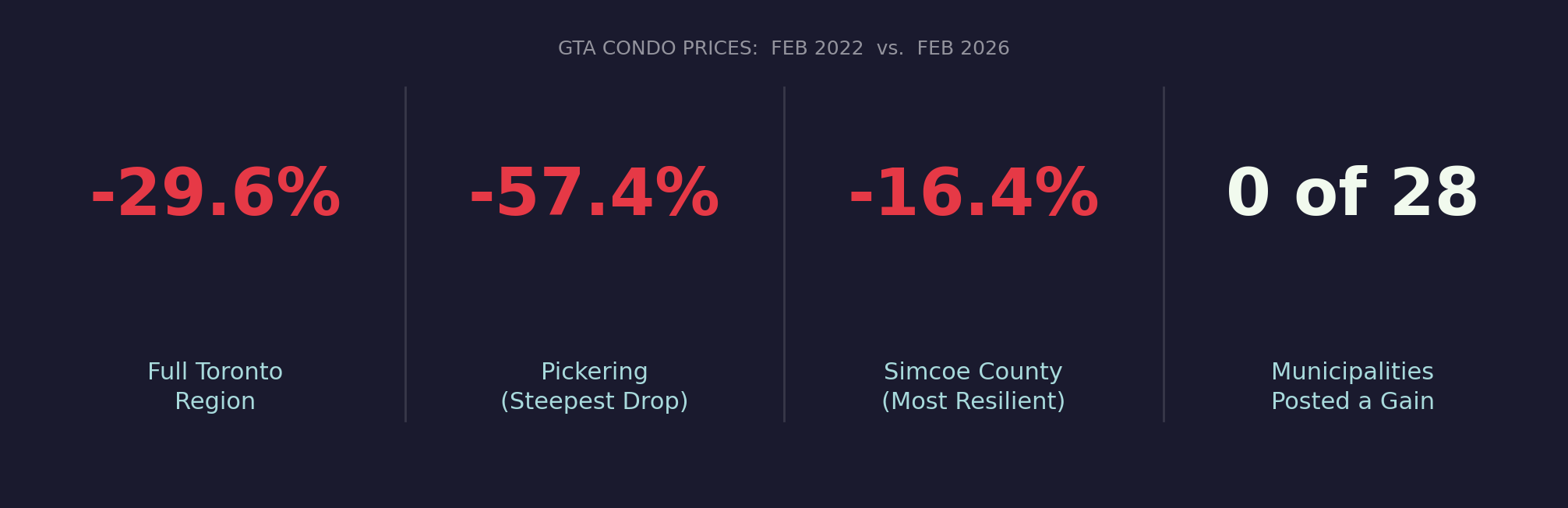
TRREB data comparing February 2022 to February 2026 tells the story in stark terms. Across the full Toronto region, the average condo price has fallen from $769,600 to $542,200, a decline of 29.6%. That's nearly a third of peak value, gone. And in some municipalities, the losses are far worse.
The Full Picture: Every Municipality, Side by Side
Before diving into the analysis, here's the complete dataset. Every number below is sourced from TRREB, comparing February 2022 condo prices to February 2026.

The data speaks for itself. Not a single municipality posted a gain. The question isn't whether prices fell. It's where they fell most, and what the pattern tells us.
The Hardest-Hit: Where a Third or More of Value Disappeared
Several municipalities stand out for the sheer magnitude of their declines.
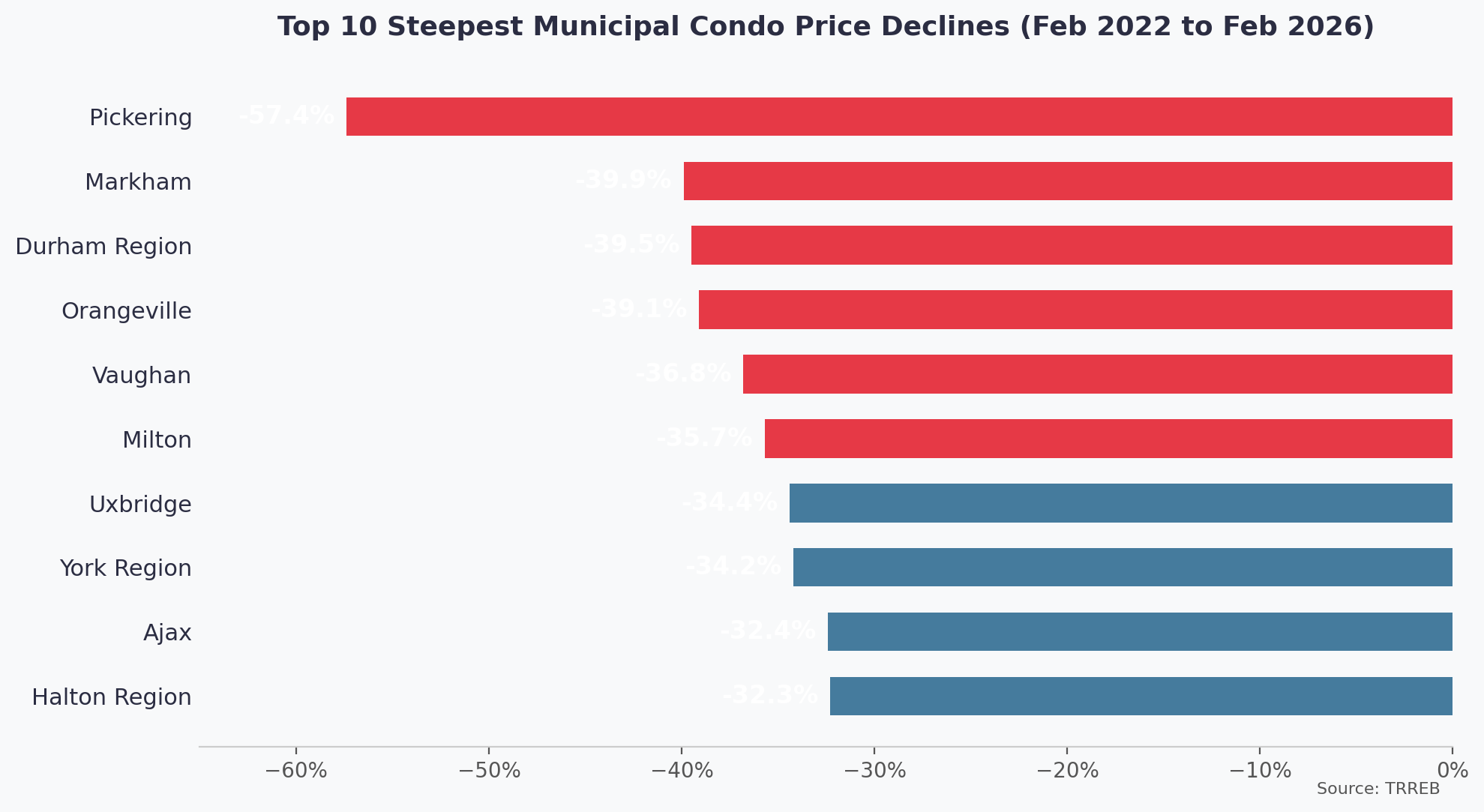
Pickering: -57.4%. This is the outlier in the dataset. Condo prices in Pickering fell from $1,101,600 to $468,800, a loss of more than $632,000 per unit. Pickering's 2022 condo prices were unusually elevated relative to the rest of Durham Region, likely reflecting a small sample of higher-end product. The correction brought Pickering's pricing back in line with its neighbours, but the percentage decline is staggering nonetheless. For anyone who purchased at or near the peak, the math is brutal: a buyer who put 20% down ($220,320) has seen their entire equity wiped out several times over.
Markham: -39.9%. Markham condos dropped from $902,600 to $542,600, shedding $360,000 in value. Markham had some of the highest condo prices in York Region in 2022, driven by demand from buyers who were priced out of the City of Toronto's detached market. That premium has largely evaporated.
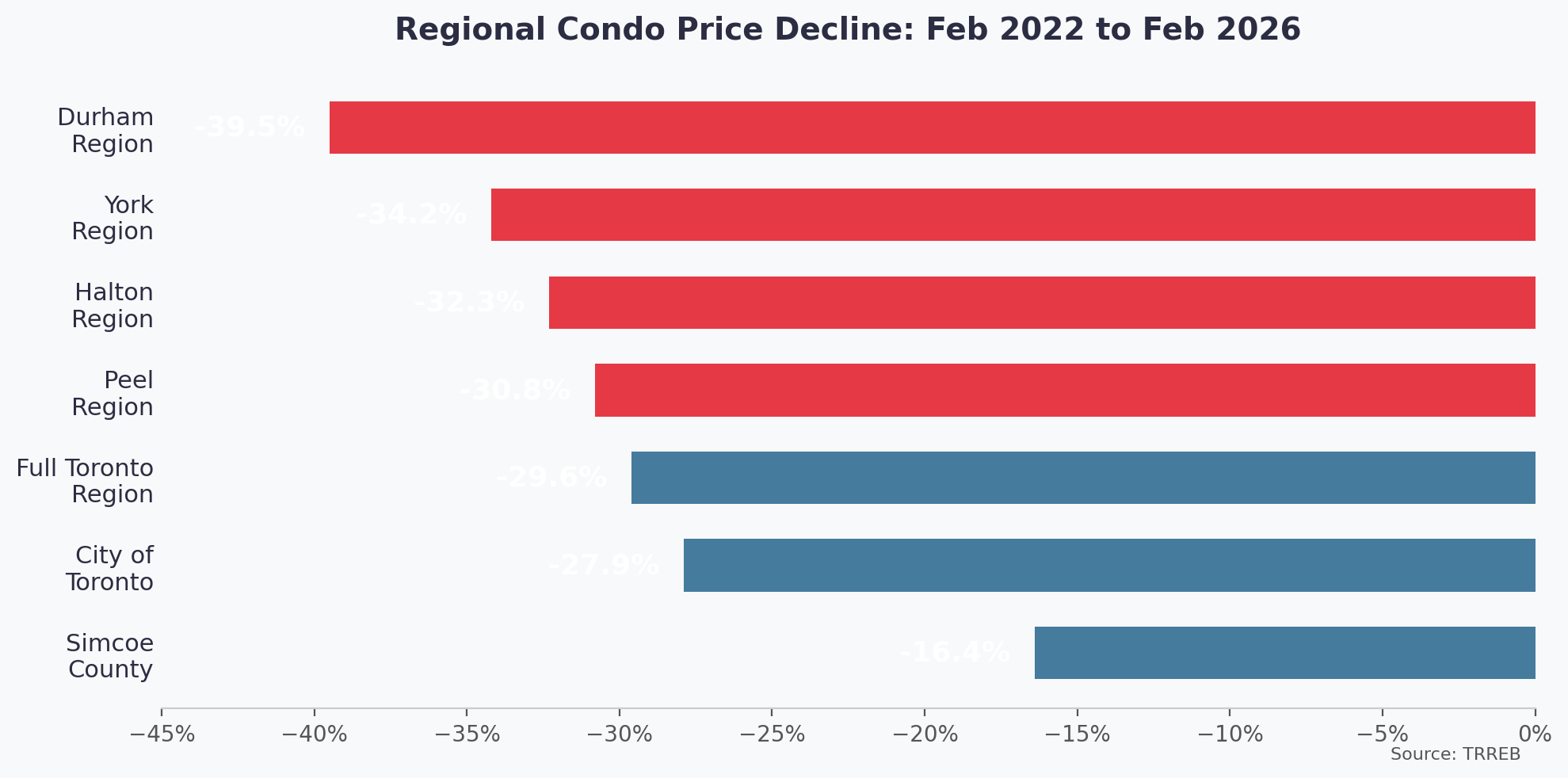
Durham Region: -39.5%. The regional average tells the broader story. Durham was one of the GTA's hottest markets during the pandemic boom, with prices in many municipalities doubling between 2020 and 2022. The correction has been proportional to the run-up.
Orangeville: -39.1%. Another market that ran hard during the pandemic-era boom and has since given back nearly all of those gains. At $399,100, Orangeville now has the lowest average condo price in the TRREB coverage area.
Vaughan: -36.8%. Down from $825,600 to $521,800. The Highway 7 corridor, once a magnet for new condo development, has been hit by both falling resale prices and a wave of completed inventory.
Milton: -35.7%. Milton's condo market saw significant new supply come online during the correction, which compounded the downward price pressure. A drop from $804,800 to $517,800 represents a loss of nearly $287,000 per unit.
The Relative Survivors
Not every municipality was hit equally. A few areas held up comparatively well, though "well" is relative when the floor is a 16% decline.
Simcoe County: -16.4%. At $619,900 to $518,100, Simcoe saw the smallest regional decline. Its relative affordability in 2022 meant it had less distance to fall. Simcoe condos were never caught up in the speculative frenzy to the same degree as the inner suburbs.
Halton Hills: -17.9%. A similar dynamic: more modest 2022 pricing ($635,200) and a smaller, less liquid condo market that didn't attract the same level of investor activity.
Oshawa: -18.8%. Oshawa's lower 2022 starting price ($517,300) insulated it somewhat. At $420,000, Oshawa now offers the second-lowest average condo price in the GTA after Orangeville.
Newmarket: -19.7%. Another municipality where relatively modest 2022 pricing translated to a less severe correction.
The pattern is clear: the municipalities that saw the steepest declines were generally those with the highest 2022 prices relative to local fundamentals, the most investor-driven demand, or the most new supply entering the market during the downturn. The areas that held up best were those where pricing never got as disconnected from local affordability in the first place.
The City of Toronto: -27.9%: The City of Toronto itself sits in the middle of the pack at -27.9%, with prices falling from $776,700 to $560,000. That's a loss of $216,700 on the average unit, meaningful but less severe than what played out in the 905 suburbs.
This relative resilience makes sense.
The 416 has deeper demand fundamentals: proximity to employment, transit infrastructure, and a broader buyer base that includes both end-users and investors. During corrections, core urban markets tend to hold up better than suburban areas that experienced the sharpest pandemic-era price gains.
That said, -27.9% is not a rounding error. A buyer who purchased a $776,700 condo in February 2022 with 20% down ($155,340) is now roughly $61,000 underwater on their mortgage, owing more than the property is currently worth.

What the Data Reveals About the Correction
Several patterns emerge when you look at the full dataset.
The pandemic premium has been fully unwound. Municipalities that experienced the most dramatic pandemic-era price increases (Durham, Orangeville, Milton, Markham) have also experienced the steepest corrections. The "drive until you qualify" trade that pushed buyers into the outer suburbs at increasingly elevated prices has reversed. In many cases, condo prices in these areas have fallen back to or below their pre-pandemic levels.
The suburbs overshot more than the core. The City of Toronto's -27.9% decline, while substantial, is notably less than the 30%–40% declines seen in the 905 regions. York Region fell 34.2%. Durham fell 39.5%. Peel fell 30.8%. Halton fell 32.3%. The correction has been most severe in the areas that were most dependent on speculative buyer demand and where new supply continued to flow during the downturn.
Investor-heavy markets got hit hardest. Markham, Vaughan, and Mississauga, all major centres for condo investor activity, saw declines well above the regional average. This aligns with the broader narrative: 77% of Toronto condo investors with new mortgages are cash-flow negative, and investor demand has essentially evaporated. When the buyer base that drove much of the 2020–2022 price appreciation exits, the correction is proportionally severe.
Lower price points offered insulation. Oshawa, Newmarket, Halton Hills, and Simcoe County all had 2022 average condo prices under $650,000, below the GTA median. These more affordable markets attracted fewer speculative buyers and experienced more modest run-ups, which translated to more moderate corrections.
What This Means in Dollar Terms
Percentages can feel abstract. Here's what the correction looks like in real money for a buyer who purchased at the February 2022 peak with a standard 20% down payment.
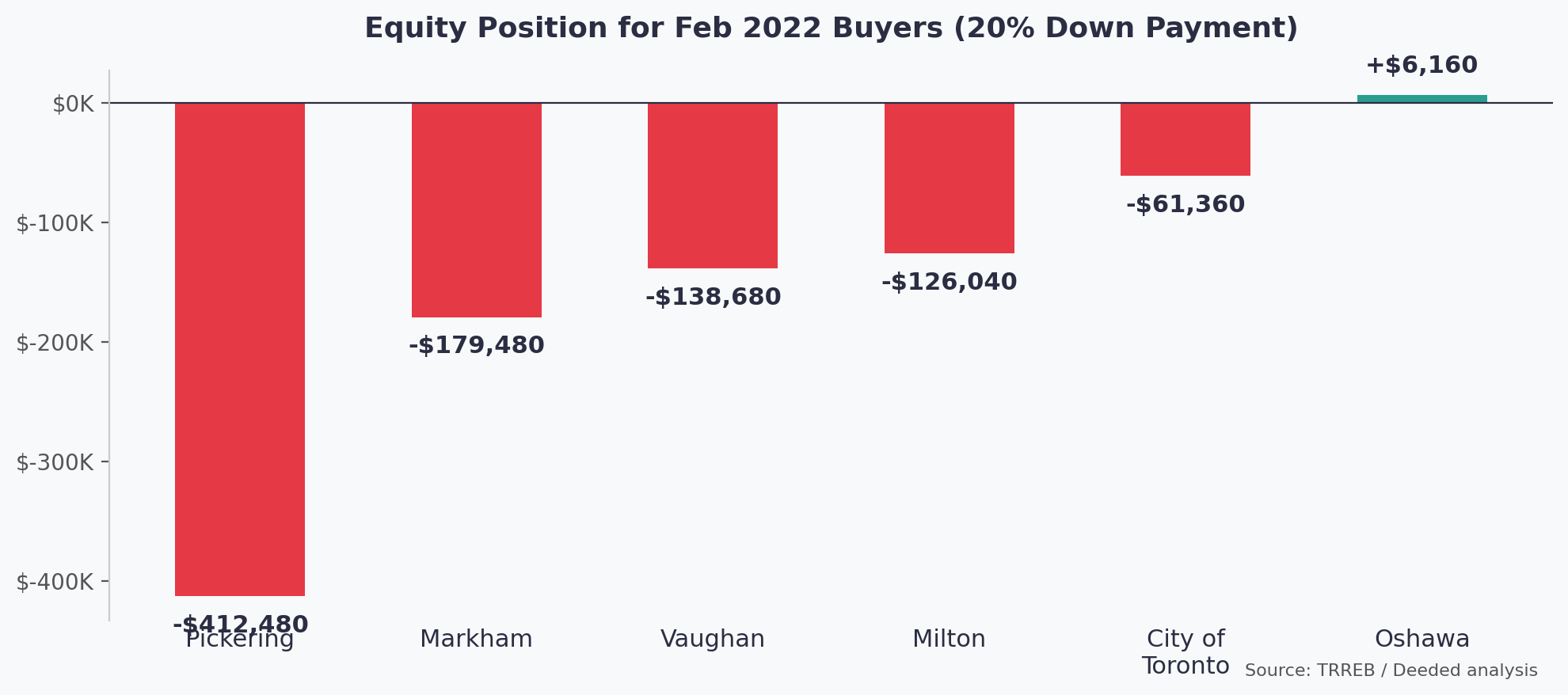
In most municipalities, a 20% down payment buyer from February 2022 is now underwater, with their property worth less than their outstanding mortgage balance. Only buyers in the most moderately priced areas, where declines stayed below 20%, have managed to preserve any equity.
For anyone who bought with less than 20% down, the picture is even worse. A 5% down payment buyer in Markham, for example, would be more than $300,000 underwater today.
Looking Ahead
The TRREB data makes the scale of the correction undeniable. Nearly 30% of average condo value across the full Toronto region has evaporated in four years. In the hardest-hit municipalities, buyers who purchased at the peak have lost hundreds of thousands of dollars in equity.
The question now is where the floor is. Several factors suggest the worst of the price declines may be approaching their end: the pipeline of new condo completions is declining sharply, interest rates are significantly lower than their 2023 peaks, and TRREB estimates over 100,000 buyers are sitting on the GTA sidelines waiting for the right moment to re-enter.
But the data also offers a cautionary message. Real estate corrections of this magnitude take time to heal. The condo buyers who purchased at the February 2022 peak are unlikely to recover their equity for years, and in some municipalities, potentially the better part of a decade. For current buyers, the correction has created genuine affordability improvements. For existing owners, the numbers in this chart represent a difficult reality that no amount of market optimism can paper over.
The market will eventually recover. It always does. But this data is a reminder that timing matters, location matters, and the belief that prices only go up was always a bet, not a guarantee.
Frequently Asked Questions
How much have GTA condo prices fallen since 2022?
Across the full Toronto region, condo prices fell 29.6% between February 2022 and February 2026, from $769,600 to $542,200, according to TRREB data. Some municipalities saw even steeper declines: Markham dropped 39.9%, Durham Region 39.5%, and Pickering 57.4%. Not a single GTA municipality posted a price gain over this period.
Which GTA municipality saw the biggest condo price decline?
Pickering recorded the largest decline at 57.4%, with average condo prices falling from $1,101,600 in February 2022 to $468,800 in February 2026, a drop of over $632,000. This outsized decline likely reflects sample-size effects and the unwinding of unusually elevated 2022 pricing relative to the rest of Durham Region.
Which GTA areas held up best during the condo correction?
Simcoe County saw the smallest decline at 16.4%, followed by Halton Hills at 17.9% and Oshawa at 18.8%. These areas generally had lower price points in February 2022 and attracted less speculative investor activity, which insulated them from the sharpest corrections.
Are GTA condo prices still falling in 2026?
Yes. As of February 2026, GTA condo prices continue to decline year-over-year, with the average condo apartment down approximately 8.9% from February 2025. Most analysts expect prices to stabilize in the second half of 2026, but a return to February 2022 peak pricing is likely years away.
How much equity has a typical 2022 condo buyer lost?
A buyer who purchased the average GTA condo ($769,600) in February 2022 with a standard 20% down payment ($153,920) is currently approximately $73,480 underwater, with their property worth less than their outstanding mortgage. In harder-hit municipalities like Markham or Vaughan, buyers are $130,000–$180,000 or more underwater.
Why did suburban condos fall more than City of Toronto condos?
Suburban municipalities, particularly in York Region (-34.2%), Durham Region (-39.5%), and Peel Region (-30.8%), experienced steeper pandemic-era price increases driven by speculative demand and the "drive until you qualify" trend. The City of Toronto's -27.9% decline, while significant, reflects deeper demand fundamentals including proximity to employment, transit, and a broader buyer base.
Unlock Your Seamless Closing Experience
Your Journey to a Worry-Free Closing Starts Here!